
Wood County Projected Versus Actual Release
TDCJ defines a Projected Release Date as a Classification and Records Office estimate of when a current inmate may be released if parole does not occur sooner. The offense title, offense date, sentence, credits, and eligibility rules shape the calculation. It is forward-looking. It is not a book-out time, release certificate, or proof that the person left a state unit.
Later in release processing, a current TDCJ record can show a Scheduled Release Date and Scheduled Release Location. Those fields indicate a more developed plan, yet they can still change. Actual release means the custodian completed the required legal and records steps and recorded the departure. A county jail book-out and a TDCJ prison release are also distinct events.
- Projected Release Date
- A TDCJ calculation of a possible future release point.
- Maximum Expiration Date
- The sentence-end calculation based on the governing record and applicable credits or rules.
- Scheduled Release Date
- A later processing date displayed after release planning advances.
- Discharge
- The formal completion shown by the responsible correctional record, which is different from release onto supervision.
Find Wood County Projected Release Dates
First identify the custodian. The Wood County Jail route fits local pretrial custody and county sentences. The TDCJ route fits a sentenced state prisoner. A TDCJ number, SID number, county booking number, and court case number are not interchangeable. Use an exact identifier whenever possible, and verify the name and date of birth against the record.
- Confirm whether the person is at Wood County Jail, a TDCJ facility such as Clyde M. Johnston Unit, or another authority.
- For current state custody, open the official TDCJ inmate search. Search by TDCJ number, SID number, or exact last name with at least a first-name initial.
- Read the Projected Release Date on the matching current detail. Also note the unit, offenses, and any later Scheduled Release Date or Location.
- For a Wood County sentence, obtain the signed judgment, jail-credit terms, and maintained jail release date from the court and jail. Do not copy a state-prison formula.
- If a former TDCJ inmate no longer appears, use the email history route and submit a public-information request for the release certificate, discharge date and type, and release location.
- Confirm a pending date near release through the proper status line and then obtain the actual release record.
The official TDCJ inmate search shown below is the current-prisoner route.
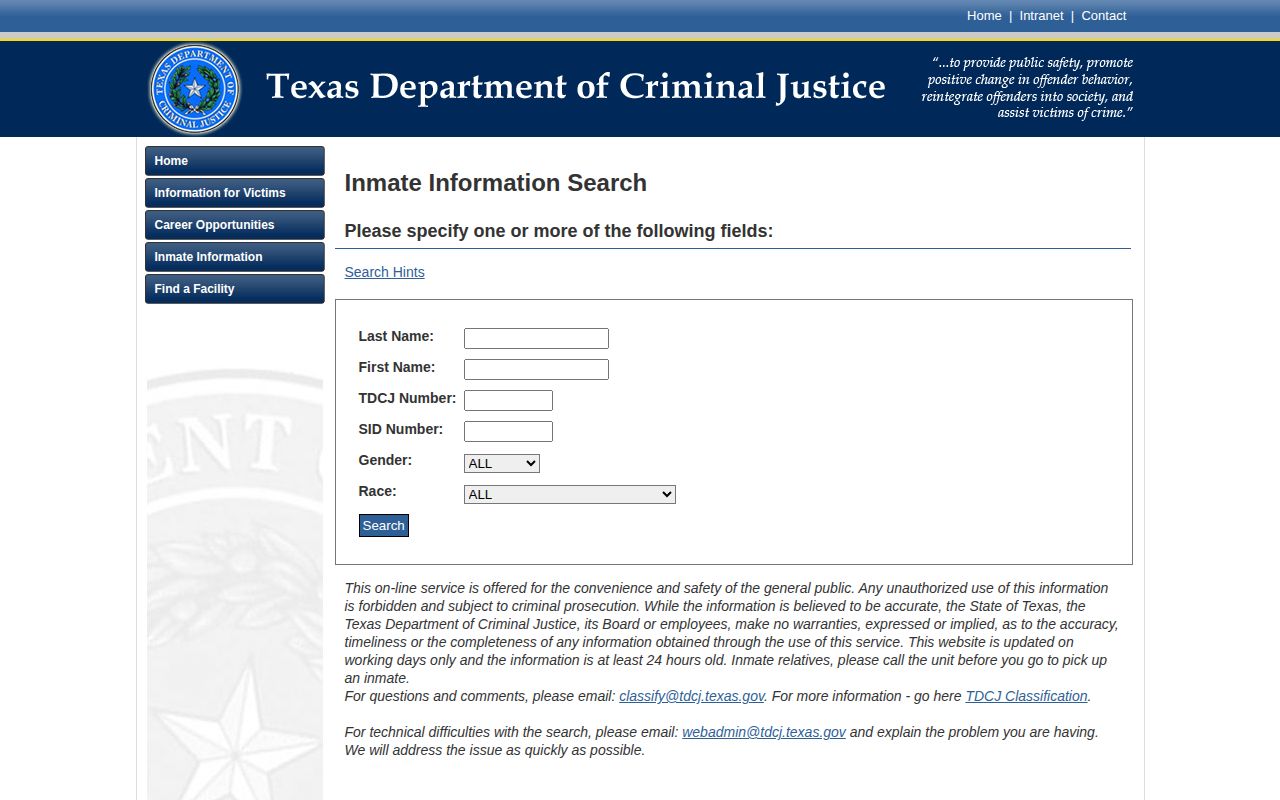
TDCJ states that its search includes only people currently incarcerated in its facilities. It updates on working days, and information is at least 24 hours old. A person who no longer appears needs the historical and records-request route.
Texas Release Date Computation
Texas has no general 85% rule. Importing that percentage from another state would give a false Wood County release estimate. Texas Government Code Chapter 508 uses offense-specific parole and mandatory-supervision rules. Section 508.145(d) generally places specified serious or violent categories, deadly-weapon findings, and other listed cases at one-half of the sentence in actual calendar time or 30 years, whichever is less, with a two-year minimum. Good time does not count toward that calendar-time threshold.
For many other prisoners, §508.145(f) generally uses actual time plus good time equaling one-quarter of the sentence or 15 years, whichever is less. Those are eligibility points, not release dates. The current statute includes exclusions, amendments, and offense-specific terms. A person who reaches eligibility may be denied parole, required to complete a program, or reviewed again later.
Section 508.147 addresses mandatory-supervision timing. Section 508.149 lists ineligible offenses and permits discretionary denial based on statutory findings. For eligible offenses before September 1, 1996, TDCJ describes a comparison of flat time plus good time to the sentence. For later eligible offenses, the calculation may also require Board approval. A denial can move the projected date to the Maximum Expiration Date, while later approval can move it earlier.
Texas Government Code Chapter 498 governs classification and good-conduct time. Good-conduct time can affect classification and eligibility calculations. It does not shorten the court-imposed sentence itself. Eligibility simply permits consideration.
Parole review adds a decision layer to the arithmetic. TDCJ says the Parole Division identifies a case before eligibility, prepares the file, and sends it to the designated Board office. A three-member panel votes, with two matching votes finalizing the decision. A favorable code may permit release when eligible, set a later month, or require a program first. A denial can set another review or require service of more of the sentence. None of those votes proves that records staff finished release processing.
Mandatory supervision also requires careful terms. For some eligible cases, actual time and accrued good time reach a statutory point, but §508.149 excludes listed offenses and allows a panel to deny discretionary mandatory supervision on required findings. The exact offense date matters because the statutory framework changed over time. Calculating from sentence length alone omits facts that TDCJ must review.
Wood County Jail Date Channel
County-jail calculations are not a smaller version of the TDCJ formula. A pretrial detainee has no set release date because bond, dismissal, court action, new warrants, and transfer decisions may still change the custody path. A sentenced Wood County inmate's timing follows the judgment, lawful jail credit, locally maintained good-conduct records, holds, and release authority.
Wood County publishes no county projected-release calculator or weekend-release policy. Ask the court for the signed sentence or release order and ask the jail for the maintained book-out or release date. The official Public Access portal may help connect Sheriff Jailing, Sheriff Bond, and criminal-case records, but the county has not published a projected-date field dictionary.
A bond transaction can explain authority for release without proving the physical release time. A court setting also is not proof the event occurred. Pair the order with an affirmative jail record, and ask whether a departure was to the community or a transfer to TDCJ, another county, or another authority.
Wood County Release Date Changes
A displayed date can move because a sentence computation is a live records process. Changes may arise from credits, legal rulings, new custody obligations, Board votes, or errors corrected during audit. Do not calculate travel or pickup solely from a screen. Confirm close to the event.
| Factor | Possible effect | Best confirmation |
|---|---|---|
| Good-time forfeiture or restoration | Changes credit and eligibility calculations | TDCJ classification and records information |
| Classification change | Can alter how good-conduct time applies | Current correctional record |
| New sentence or court credit | Can move the controlling date | Signed judgment and updated computation |
| Detainer or hold | May send the person to another authority | Custodian record and receiving agency |
| Parole or mandatory-supervision decision | Can move, condition, or deny an earlier route | BPP vote and Parole Division status |
| Release audit | Can correct the date before departure | Scheduled field and final release certificate |
A detainer is a request or legal basis for another authority to take custody. It can make a departure from one facility a transfer rather than community release. The destination matters as much as the date.
Wood County Release Audit Timing
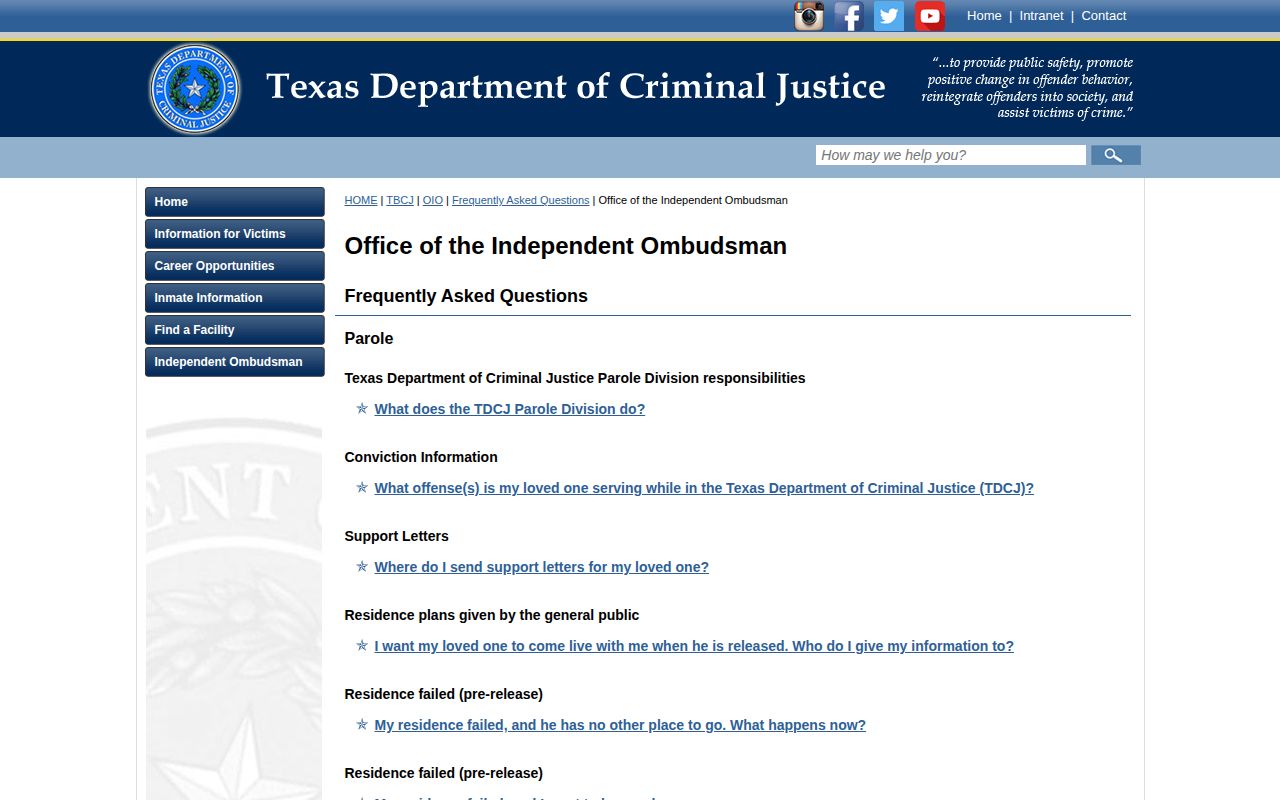
After a favorable Board decision, TDCJ records staff must receive the release certificate and audit the sentence computation. The TDCJ Ombudsman FAQ gives an approximate 14 to 21 business-day interval for that audit and calculation. It also warns that a Scheduled Release Date can change without notice, including on the date shown.
The official TDCJ scheduled-release guidance is shown below.
The audit interval is not a promise for every case. Program conditions, detainers, revised court credit, records corrections, and Board action may still affect processing. Families should wait for the actual scheduled location and direct confirmation before arranging transportation.
Former Wood County TDCJ Records
TDCJ's free email information route can supply a number, location, offense of conviction, prior and current incarceration history, and a Projected Release Date. Send a full name and seven-digit TDCJ number to pia@tdcj.texas.gov. If the number is unknown, TDCJ describes exact date of birth, or approximate age plus county of conviction, as identity alternatives.
For documentary proof, use the TDCJ Public Information Act route. Request the incarceration history, release certificate, discharge date and type, and release location for the named commitment. Mail can be sent to TDCJ Public Information Request, P.O. Box 4017, Huntsville, TX 77342. A narrow request is easier to match than a broad demand.
The TDCJ Classification and Records function updates its system for discharged offenders and responds to open-records requests. This records path fills the key gap left by the current-only public locator.
Telephone routes can resolve different stages. General TDCJ locator information is available at 936-295-6371 or 800-535-0283 during published weekday hours. An exact date of birth is required when no TDCJ or SID number is available. Before a Board vote, use 844-512-0461 for parole-review status. After a vote to release, use 512-406-5202 for Parole Division release status. Giving the correct identifier and calling the stage-specific line reduces the chance of receiving an answer about the wrong part of the process.
For a county release date, direct the record request to Wood County instead. Identify the booking, date range, and court case. Ask for the maintained book-in and book-out time, release authority, bond record, and transfer destination if maintained and public. Texas retention schedules make the county jail register permanent and cover supporting release records for defined minimum periods, but those rules do not promise that the live portal keeps the same entry visible.
Confirm Wood County Actual Release
Before a Board vote, individual review status is available at 844-512-0461. After a vote to release, the Parole Division status line is 512-406-5202 and requires a TDCJ or SID number or date of birth. These numbers serve different stages and should not be treated as one general hotline.
A future custody alert can add timely notice. The Wood County VINELink check explains the specific-person search and registration steps. Still, VINE data can lag. The final chain is the projected date, any Board outcome, release audit, scheduled location, and actual release or discharge record.
Note: Never infer completed release from a missing TDCJ result, a court setting, or a date that has not yet passed through the custodian's final audit.