
Wood County Parole Versus Probation
Parole and probation can both place rules on a person in the community, but their legal sources differ. The Texas Board of Pardons and Paroles makes parole, mandatory-supervision, condition, and revocation decisions. The TDCJ Parole Division then supervises a person released from prison. Wood County probation begins with a court order. The Wood County Community Supervision and Corrections Department, or CSCD, administers that local order. Although TDCJ's Community Justice Assistance Division helps oversee the statewide probation system, local CSCD staff are not TDCJ employees.
A transfer is not parole. Nor is a scheduled date an actual release. The record trail should separate the Board decision, release processing, physical departure, and later supervision. Probation can also begin without a state-prison stay. The sentencing case is therefore the best first source when the custody path is unclear.
| Point | Parole | Probation |
|---|---|---|
| Legal source | Board decision after a prison sentence | Court order in the criminal case |
| Supervising body | TDCJ Parole Division | Wood County CSCD |
| Best public verification | TDCJ status, release record, and responsible parole office | Sentencing case and CSCD or court confirmation |
| What it does not prove | A favorable vote does not prove physical release | A CaseConnect screen is not a public probation lookup |
- Parole
- Supervised release from prison before the sentence fully expires.
- Probation
- Court-ordered community supervision, which may be imposed instead of confinement or after another case event.
- Mandatory supervision
- A statutory release form based on sentence and credit rules, subject to eligibility and, in some cases, Board review.
- Discharge
- The formal end of the sentence or supervision obligation shown by the responsible authority.
Verify Wood County Release Supervision
Start with the system that held or sentenced the person. A former Wood County Jail detainee might have entered probation through a local court, transferred to TDCJ, or left without any post-release supervision. A former TDCJ prisoner may be on parole or mandatory supervision, or may have discharged the sentence. Each outcome uses a different source. The TDCJ current inmate search can show parole-review information before release, but it lists only people currently incarcerated. When a name disappears, seek an affirmative release or discharge record.
- Match the full name to a case, booking number, TDCJ number, SID number, or exact date of birth. A common name is not enough.
- Decide whether the last known custody was Wood County Jail or TDCJ. County release and state-prison discharge are separate events.
- Before a Board vote, check parole-review status at 844-512-0461 or through the current TDCJ record. After a vote to release, use the Parole Division status line at 512-406-5202.
- For probation, open the sentencing case and verify the community-supervision order. Then ask the court or Wood County CSCD for the public status and responsible office.
- Record four facts when available: actual release date, legal release form, supervising agency, and current public supervision status.
The official Texas parole-review workflow shows how an individual file reaches a panel. The image below comes from that state source.
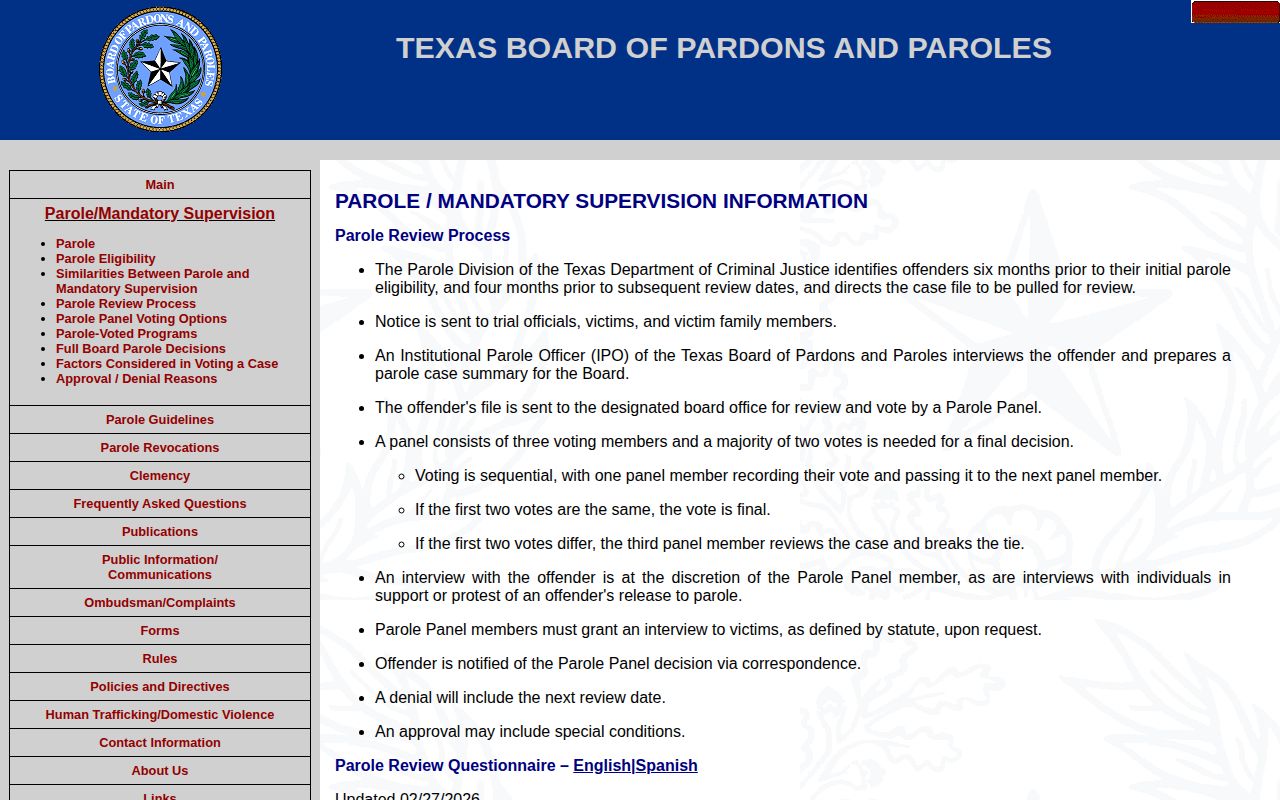
The workflow is a decision path, not a public person-by-person hearing calendar. Board workshops and meetings concern Board governance and must not be treated as individual release hearings.
Wood County Parole Office Route
Wood County is assigned to the Tyler District Parole Office in TDCJ Region I. That office is the local operational contact for parole linked to Wood County, though TDCJ may assign another office based on the actual release plan. The sheriff does not supervise state parole. When asking for public status, supply a TDCJ or SID number if possible and request the responsible office rather than private contact or residence information.
Tyler District Parole Office
3915 Market Drive
Tyler, TX 75701
Phone: 903-581-8311
Fax: 903-581-8016
The official TDCJ county-office cross-reference documents the Wood County assignment. The directory should be checked again if the supervision plan or residence points elsewhere.
Wood County Probation Record Route
The Wood County CSCD handles adult probation ordered by a local court. Its office is at 211A W. Bermuda Street in Quitman, but the official county page says not to send mail to that street address. Mail goes to P.O. Box 419, Quitman, TX 75783-0419. The public phone is 903-763-2256 and fax is 903-763-4348. The page names Darren Kindle as director.
Wood County Adult Probation
Office: 211A W. Bermuda Street
Mail: P.O. Box 419
Quitman, TX 75783-0419
Phone: 903-763-2256
Fax: 903-763-4348
Wood County Adult Probation also describes CaseConnect. That service is only for a supervisee whom a community-supervision officer has authorized and instructed to use it. It is not a public name search. A relative or records researcher should use the sentencing case, court clerk, and CSCD public contact route instead.
Wood County Parole Decision Records
TDCJ says the Parole Division identifies a case about six months before initial eligibility and about four months before a later review. Staff prepare the file and send it to the designated Board office. A three-member panel votes in sequence, and two matching votes finalize the result. A denial notice includes the next review date. These time frames describe case preparation, not a promised release hearing date.
Favorable vote codes include FI-1, which means release when eligible, and FI-2, which sets release in a future month and year. Other FI codes may require a program before release. RMS concerns mandatory supervision. Denial results can include NR with a future review, SA to serve the sentence balance subject to applicable law, or DMS denying mandatory supervision with later review. Use the current BPP vote-options page, since codes can change.
New information can cause withdrawal of a favorable vote. Release staff must still receive the certificate and audit the sentence. The sound chain is vote code, release audit, scheduled date and location, actual release, then supervision status.
No public person-by-person hearing calendar was found. The Board homepage posts dated workshops, meetings, and Texas Register agendas, but those are public governance sessions. They do not list each prisoner's review date. For an individual case, use the current inmate record or the pre-vote status line. After a favorable vote, shift to the Parole Division release-status route and then seek the final record. This distinction prevents a public Board meeting date from being misread as an inmate's parole hearing.
Wood County Supervision Violations
Conditions are the rules attached to release or a court order. They can include reporting and other case-specific duties. A reported violation does not itself establish the result. The supervising authority may investigate, seek a warrant, alter conditions when authorized, or begin a revocation process. The case record and agency status must show what followed.
An absconder is generally a supervisee whom the agency alleges has stopped reporting or cannot be located. The term does not mean the person was released without rules, and it does not by itself prove a new offense or final revocation. No verified public Wood County absconder list was found in the official research. A general warrant list should not be labeled a parole list.
Texas VINE and Wood County IVSS concern custody and court-event notices. They can help follow a new custody event, but neither service replaces supervision-office verification. For a formal result, use the revocation record, Board outcome, sentencing court, or responsible supervision office.
Property After Wood County Release
The Wood County jail publishes two narrow rules that matter after book-out. Its official jail page says property is not released on Tuesdays or Sundays during visitation hours. It also says money in an inmate account cannot be removed unless the inmate is released or the funds are used for medical or commissary charges.
Those statements do not identify the release door, establish a pickup appointment, or explain every property issue. Call the jail at 903-763-2201 about the specific released-person process. Keep the custody event separate from supervision. Tyler DPO and Wood County CSCD do not replace the jail as custodian of property or account records.
Note: A property rule can aid release planning, but it does not prove the release time or legal form of supervision.
Wood County Supervision Discharge
Supervision ends through the authority that imposed or administered it. For parole or mandatory supervision, obtain the TDCJ release and discharge history and verify the current Parole Division status. For probation, use the sentencing court record and Wood County CSCD. A completed term, court order, revocation, transfer of supervision, and discharge are not interchangeable labels.
Texas Government Code Chapters 498 and 508 govern major parts of good-conduct time, parole eligibility, and mandatory supervision. Eligibility allows consideration; it is not a release order. The offense, sentence, statutory category, Board action, and records audit all matter.
A full county release-record path, including the jail, court, TDCJ, and records-request channels, is available from the Wood County released inmate search. Pair that underlying release proof with the supervision record rather than relying on a roster disappearance.
If online sources do not settle the question, request the existing records rather than asking an office to reach a legal conclusion. For TDCJ, identify the commitment and ask for incarceration history, the release certificate, discharge date and type, and release location if public. For probation, identify the sentencing case and ask for the community-supervision order and later discharge or revocation order. Texas Government Code Chapter 552 permits access to public portions, while confidentiality and law-enforcement exceptions can require redaction or withholding. The custodian does not have to create a custom status report.
Release notices may also help establish sequence. Wood County IVSS can notify eligible registrants about county-jail-status and court events, while TDCJ has a separate Victim Services process for state custody. A county registration should not be treated as permanent coverage after transfer to TDCJ. Save the notice, but use the responsible agency's final record to establish the supervision form and end date.